- The Peggie Li Letter
- Posts
- How I Lost 15 Pounds in 6 Months and Beat My Weight Loss Plateau for Lasting Results
How I Lost 15 Pounds in 6 Months and Beat My Weight Loss Plateau for Lasting Results
My 15-Year Journey from Workaholic to Wellness Warrior

Peggie Li
June 03, 2024
This year, at 38 years old, with a body fat percentage of 30%, I am considered overweight and visibly obese. I’ve been focused on losing weight for the past year. Since having a child at 32, I’ve struggled with weight loss, experiencing fluctuations. From initially knowing nothing to learning about nutrition, psychology, and exercise, I’ve been battling weight loss for five years. Currently, I’ve hit a weight loss plateau, a significant and frustrating milestone for many dieters, where no matter what I do, I can't lose more weight and sometimes even regain it.

So how did I gain weight? Before I turned 30, I was slim and fit, maintaining a healthy body effortlessly. I never understood the struggles of being overweight. Looking back, I owe this to my parents and the healthy eating habits provided by Chinese schools, and my own vitality. I was a key member of the school dance team and loved swimming with my siblings. In elementary school, I attended a boarding school with strict military-style management, which kept me in the habit of getting up at 6 AM to run. In high school, since my home was far from school, I cycled 40 minutes each way daily, regardless of the weather, earning the nickname “Speed Queen.” At university, I attended Renmin University of China. Although the campus was not large, I lived in the west district while the main gate was in the east district, so I had to speed walk across campus multiple times daily, traveling between my dormitory, classrooms, and off-campus activities.

In 2008, I came to the United States from China to pursue a master's degree in Communication at USC. I was amazed by the variety of delicious sweets and super sweet yogurts in American supermarkets. As a sweet lover, I started buying these treats in large quantities. Additionally, the cheap and tasty burgers available everywhere became part of my daily diet. As an international student, I had to adapt to a new language environment, heavy coursework, and a brutal job market due to the economic crisis. In my first semester, I received seven internship offers, accepted two, and also worked one day a week on campus to earn more living expenses. Balancing two internships, an on-campus job, graduate courses, learning English, and adapting to American society, all amid the economic crisis, felt like a relentless storm bearing down on me. Consequently, the cheap, high-fat, high-sugar foods from American supermarkets and hamburger stores became my daily stress relief. Quickly, my weight, which I had maintained at 48 kg for ten years, soared to 52 kg within a year. Looking back, the stress and challenges I faced in my youth, and the resulting emotional eating and weight gain, seem trivial compared to those I experienced in middle age.
The second significant weight gain occurred when I was 30 and suddenly developed depression. Before that, at 29, I had established myself in the US new media field, with a bright future ahead. Starting as an unpaid intern, I spent eight years in media-related business analysis and development roles at Sony Pictures, Hollywood Reporter, Fox Networks, Leaf Group (formerly Demand Media), and DreamWorks. At 29, I became the youngest Asian director in Disney's new media department, managing YouTube influencer monetization and content production. This role marked my transformation from an insecure girl struggling with English to a confident professional leading a multicultural team.

Then, I chose to resign. On my 30th birthday, I submitted my resignation letter without having another job lined up—I quit without a safety net. I was ready to explore the next journey in life: entrepreneurship. I still remember coming home that day, telling my husband with a sense of relief, "I quit!" As a serial entrepreneur, he casually replied, "Great, let's go to In-N-Out to celebrate." And so, we marked the day of my resignation with a joyful meal at In-N-Out.


However, I wasn't truly mentally prepared for entrepreneurship. As the saying goes, "Ignorance is bliss." My step-by-step accumulation of experience in medium and large companies gave me the illusion that I could do anything. I mistakenly attributed the company's success to my own glory. When I left the company's safety net to start my own business, I realized I had been living in a sheltered environment, or rather, a big lie. The bold and overly optimistic idea of entrepreneurship burst my beautiful bubble, exposing the harsh reality—I was insignificant. I didn't even know what kind of company I wanted to create. Two months after resigning, I fell into extreme anxiety, fear, and self-doubt. When I learned that my husband's startup had only one month of cash flow left and we might soon be evicted due to unpaid rent, I had a complete breakdown—I developed depression.
At that time, I didn't realize it was depression. I only knew I often imagined jumping from the building and considered various methods of self-harm. My legs wouldn't stop shaking even while watching movies. I frequently woke up at 2 AM and couldn’t fall back asleep. The lack of sleep, barely three hours a night, felt like a heavy stone pressing on my head. I blamed myself for irresponsibly quitting when our finances were tight. I hated my selfishness, feeling worthless and guilty. To distract myself, I hiked for three hours daily, circling the park like a tiger in a cage. My mind was trapped in endless darkness with no way out. I felt helpless, believing my life was over. To cope with the immense daily pressure, I began binge eating because I no longer loved myself. A person with depression, who constantly blames themselves and feels out of control, can’t possibly care about the harm caused by overeating. Simply staying alive was an achievement. Consequently, my weight soared from 52 kg, which I had maintained for six years, to 55 kg.

According to data from the Centers for Disease Control and Prevention, the suicide rate due to depression is 14.8%. Looking back, I realize how fortunate I was to survive, similar to climbing out of a valley full of dead bodies. This grueling experience was a path I chose, unaware of its intense pain. Raised in protective environments, I naïvely thought independence was filled with glory. When I quit my job, I dreamed of achieving greatness and standing on a podium to thank my parents and society. Now, it seems incredibly childish and laughable. Escaping my comfortable 30-year cocoon of family, school, and work, I felt like I had returned to a primitive era, constantly fearing for my survival. For the first time, I saw "reality."
Next, I chose to join a startup company in China, which I'll refer to as Company A, due to confidentiality agreements. 2016, Company A had over 2,000 employees in China (by 2021, they had 110,000 globally). They were beginning their global expansion, with the US market still untapped. They urgently needed a market leader for this new venture. With an entrepreneurial spirit, I joined Company A as the first head of the US market, building it from scratch. This included setting up offices, hiring staff, and collaborating with product managers, designers, and engineers to develop and operate local apps. This laid the foundation for Product B (referred to as Product B for confidentiality) to become a leading app in the US.
However, this process was incredibly challenging for me. Everything was just starting, and to enhance collaboration between the two countries, I had to fly between New York, Los Angeles, and Beijing every month, equaling circling the globe monthly. Due to the time difference and the demands of a startup, my work schedule wasn't the typical 996 (9 AM to 9 PM, six days a week) of Chinese tech companies, but rather 007 (midnight to midnight, seven days a week). When I was starting my Saturday in the US, my colleagues in China were already working on their Sundays, so I worked on Saturdays. When I needed to rest on Sunday, they had already begun their Monday, so I continued working on Sundays. On weekdays, after a full day in the office, I would have meetings with my Chinese colleagues starting their day. My most significant stressor was the cultural differences in work styles between the US and China. Although I grew up in China, my career since graduate school has been in the US, making me unfamiliar with Chinese workplace communication and rhythms. I recall each business trip to the China headquarters involved eating at least six buns in their cafeteria, and nearly every meal during the startup period was a binge to cope with the extreme mental and physical stress. Unsurprisingly, my weight increased from 55 kg to 58 kg in less than two years.

At 32, life had already ground me down significantly. Despite still struggling with depression, my ability to handle setbacks improved by 50%, and I became more optimistic. I got pregnant and left Company A, rejecting lucrative offers from other companies, deciding to embark on the challenging path of entrepreneurship while pregnant. The ensuing entrepreneurial journey proved more painful than I had anticipated. Friends warned me that pregnancy and childbirth were tough and that doing both while starting a business was impossible. I dismissed their concerns, believing I could handle anything, even if depression hadn't killed me.
Looking back, I realize how naïve and foolish I was.
I remember flying to Northern California's famous Y Combinator for a women entrepreneurs' conference at 35 weeks pregnant, feeling self-conscious as the only visibly pregnant entrepreneur. Later, I experienced a difficult labor due to severe swelling and high blood pressure, resulting in an early termination and a grueling three-day labor with a fourth-degree tear. Remarkably, a week after giving birth, I resumed my unpaid entrepreneurial efforts, thanks to my mom flying in from China to help care for my newborn

I remember hiding the constant milk stains on my shirt during online investor meetings. I carried a heavy breast pump to investor networking events. I endured severe mastitis, fake-smiling to hide my pain through an hour-long meeting with a potential investor, only to suffer through Los Angeles traffic for another three hours afterward. The pain of mastitis was even worse than childbirth. Reflecting now, the immense suffering during pregnancy and postpartum was due to focusing all my energy on entrepreneurship instead of fully dedicating time to pregnancy and childbirth.
Regardless, I didn't stop my entrepreneurial journey.
Five months after my child was born, I secured my first valuable investment. I began the rocky yet exhilarating journey of founding PrismPop, an online UGC community for women to share beauty product reviews and recommendations. As the founder and CEO, I led the company from zero to raising $5 million over five years through angel, pre-seed, and seed rounds, growing to a $15 million valuation with 150,000 MAUs and over 200% quarterly growth in the fifth year. For cost and efficiency, I based product and market operations in Los Angeles and tech development in China. Remarkably, this entire process unfolded during the COVID-19 pandemic, with all cross-country recruitment, bilingual team collaboration, project development, and marketing operations conducted online. Miraculously, I didn't completely lose my sanity. With my mother unable to travel to the US due to COVID-19, my husband and I had to care for our newborn alone.

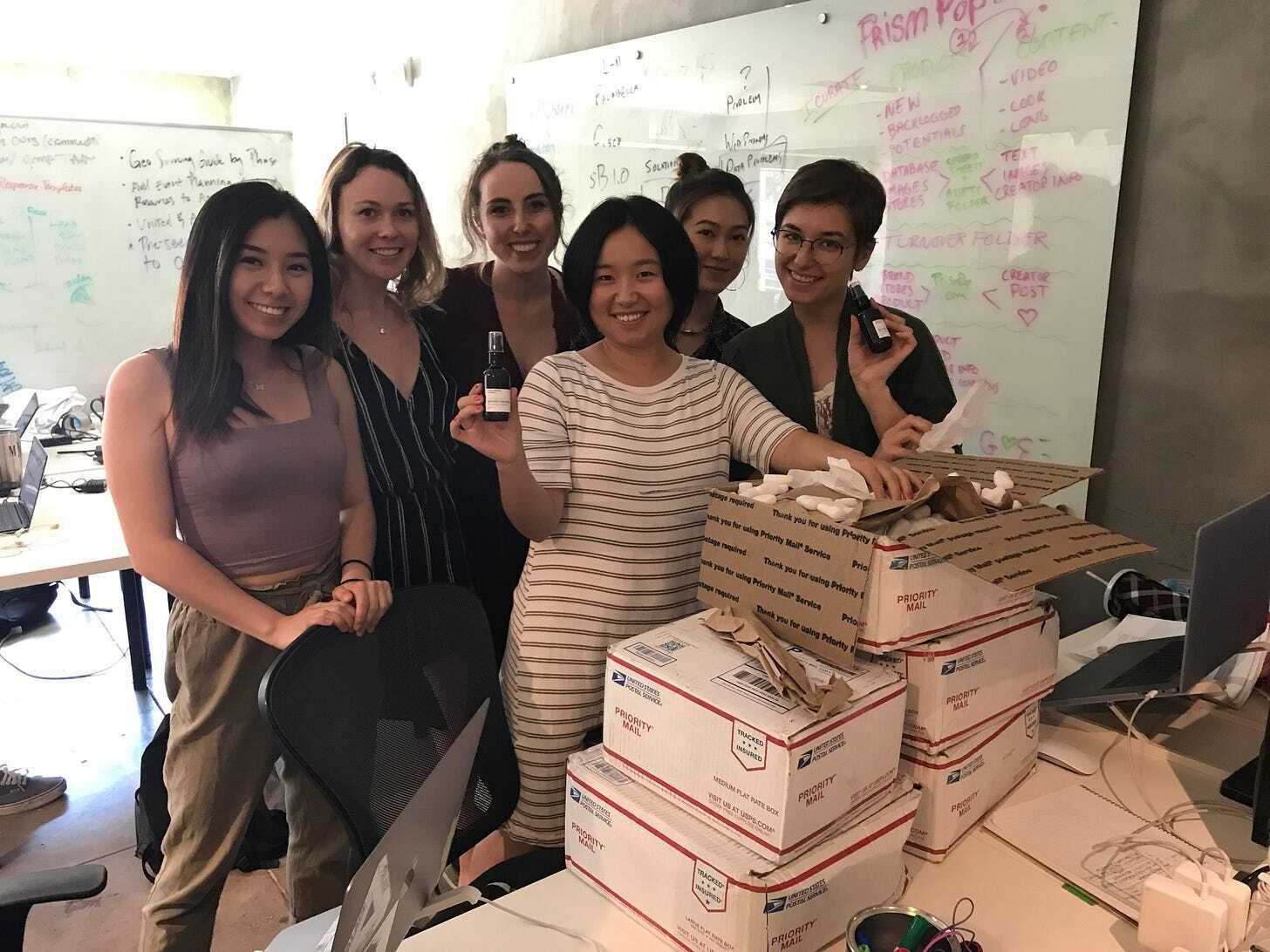
Although I didn't completely lose my sanity, I still remember that night when, after bathing my child, I worked late into the night, finally collapsing onto the cold wooden floor in tears. It was the first time I experienced a relapse of depression due to exhaustion from work. I recall cooking for three hours straight for my child, realizing I had to bear the responsibilities of both raising a child and earning money through my startup, while my husband didn't provide enough support. When depression hit hard, I smashed the kitchenware in front of my husband. After a 15-minute meditation, I wiped my tears, put on a composed face, and resumed an online meeting with investors, pretending nothing had happened, leaving my husband in shock. Although he later evolved into a supportive father and husband, that difficult period became a core memory of our family.
In February 2024, my startup came to an abrupt end. After considering all options, I decided to close the company I had spent five years building. Years of intense work, separation from my three-year-old due to work and COVID-19, 14-hour workdays, and a fragile marriage pushed me to my limits. The drastic changes in the US-China funding environment in mid-2023 also contributed. But the most critical reason was myself; I take full responsibility for the decision. Despite the valuable experiences, this venture ultimately ended in failure. For the first time, I realized that in a society that values perseverance and resilience as success foundations, choosing to end something can be more challenging than continuing.
Facing the disappointing decision for investors, employees, partners, and my family, my weight shot up from 58 kg to 63.5 kg in three months. Although I was only 36, my body age measured a staggering 46 years. The relentless struggle had aged my body by ten years, leaving me looking bloated, overweight, and exhausted.

The past five years of my relentless struggle seemed to have turned to ashes. In an era where personal value is defined by income, wealth, job title, power, and company valuation, my 15 years of societal identity were shattered. Though saddened, I did not cry because I willingly accepted the risks of entrepreneurship. What truly broke me was leaving my beloved child for a year, missing his precious growth from age three to four. This choice tore my heart apart, showing me that no achievement or wealth could compensate for this maternal loss. For the first time, I also realized the immense emotional and physical support my husband provided, something I had taken for granted as a workaholic. And for the first time in my 36 years, I saw how little I cared for myself, always putting my needs last, allowing work to ruin my health to the point of obesity and exhaustion.

When my career hit rock bottom and my societal labels were shattered, I decided not to jump into another venture immediately. For the first time, I chose to slow down, return to my family, spend time with my child, repair and nurture my marriage, enjoy the seasons, and start losing weight. Alongside physical training, I began growing mentally and spiritually, practicing unconditional self-love, and exploring questions about my identity, self-worth, the root of my depression, and my purpose. One day at a clinic, I saw on a TV: "You must first decide to love yourself; it is the only way to succeed in losing weight." I knew I was embarking on an exciting new chapter in life.
Chapter 2: Meeting The Weight Loss Plateau
Before I started losing weight, I always thought it wasn't a difficult task—just eat less and exercise more. Looking back a year later at my previous shallow understanding of weight loss, I find it naive and amusing.
Since I started my weight loss journey, I successfully lost 7 kilograms (15 pounds) in seven months, going from 63.5 kilograms down. From building an awareness of food calories, to trying 24-hour fasting, 48-hour fasting, and 72-hour fasting, to preparing home meals, walking more than 10,000 steps daily, doing 45 minutes of home workouts each day, recording my diet, keeping a weight loss journal, and reflecting daily. I tracked my daily water intake to ensure I drank enough, practiced yoga regularly, increased my badminton training, hired a professional nutritionist to adjust my daily diet, used MyFitnessPal to track my calorie intake and macronutrients, and used AutoSleep to monitor my sleep and ensure I got enough rest.


Although I successfully lost 11% of my body weight, reducing my body age from 46 to 39 years old (making me 7 years younger), I am still in the overweight category. At 57 kilograms, I was still 9 kilograms away from my goal. So, I kept trying to lose more weight, but the dreaded weight loss plateau arrived. No matter how disciplined and hard-working I was, my weight stayed around 57 kilograms for eight months. During this time, my weight even showed signs of increasing again. I had to rely on constant adjustments and self-discipline to maintain my weight at 57 kilograms and prevent it from returning to its original state.


According to multiple reports, 80% to 95% of people who lose weight through dieting will regain their original weight after stopping the diet. My husband is one of those who have been overweight since childhood. Over the past few years, he has tried to lose weight through dieting and exercise several times, but each time, he eventually stopped due to sudden stress in life, leading to regaining the lost weight and sometimes even gaining more. I used to criticize him without any empathy, thinking that he lacked willpower, was irresponsible, and had no self-control. It wasn't until I experienced weight loss, regaining weight, and then struggling for 365 days that I understood the hardships of being overweight. As we age, losing weight becomes even more challenging. It truly is a rocky road, like the ups and downs of the stock market. I genuinely sympathize with everyone dedicated to losing weight; it's not easy at all.

Regarding the principles behind the weight loss plateau, Dr. Fung's book, "The Code of Obesity," provides an excellent explanation. Our bodies are incredibly precise instruments in a state of dynamic balance. When you eat less, your body's metabolism (energy expenditure) also decreases. So, when your body adapts to a lower-calorie diet, your daily energy expenditure will reduce to a new level to ensure you don't continue losing weight. The primary goal of our bodies is to lower energy expenditure to protect us from starving.
When you increase your exercise, this precise instrument of your body will unconsciously make you eat more, subtly compensating for the excessive energy loss due to increased activity. In the end, whether it's dieting or increasing exercise, your powerful body will ultimately adjust to adapt to the new circumstances, keeping your weight stable.
In ancient times, this strong and precise instrument of our bodies protected us from starving when food was scarce and ensured we didn't exhaust ourselves to death by overexertion while hunting. However, in modern society, not only is there an abundance of resources, but the digital age also drives people to work while sitting all day, significantly reducing physical activity. The stress of work keeps us constantly under pressure and threat, continuously secreting stress hormones that stimulate overeating. Our body's instrument ensures that the excess fat is not burned, leading to long-term obesity and various related diseases.
In other words, as long as you are trying to lose weight, whether you are poor or wealthy, young or old, male or female, you will encounter the weight loss plateau. No one can escape this stage. This is determined by our human genes for self-protection, which is manifested by various issues in modern society.

Chapter 3: How I Overcame the Weight Loss Plateau and Achieved a Long-Term, Healthy Ideal Weight
I once spent $300 hiring a weight loss nutritionist for two months. During those two months, my weight did decrease by 1.5 kilograms under her guidance, but my weight quickly rebounded to its original point within a week after the sessions ended. This clearly showed that relying solely on dietary adjustments might temporarily break through the plateau, but it cannot achieve a long-term ideal weight. However, there was an unexpected gain: through the nutritionist's insistence on daily sharing my diet records with her, I realized my average daily intake was 1700 calories, while my Total Daily Energy Expenditure (TDEE) was 1826 calories. This meant that the key reason I couldn't break through the weight loss plateau was that my daily calorie intake was almost the same as my energy expenditure. Only when energy output consistently exceeds energy input (for example, by a daily deficit of 500 calories) can sustained weight loss be achieved.
The problem was that I had set a goal of 1300 calories per day for myself, and I always believed I could reach this target. However, through daily diet records and careful observation, I found that after 365 days of weight loss training, my average daily intake remained at 1700 calories. Even if there were a few days each week when I managed to consume 1400 calories, my body always found a smart way to compensate, like during family gatherings on weekends, travel feasts, friends' gatherings, tasting food while cooking for my child, family, and friends urging me to eat, binge eating impulses due to hormonal changes during menstrual periods, sudden work stress, or unexpected stress related to my child. In other words, given my current behavioral and psychological patterns, my weight would not change at all and might even increase with age and decreased metabolism.
This is likely the same result most career moms will see if they don't commit to weight management.
Before losing weight, I once thought weight loss was the easiest thing to control. I used to believe that if I couldn't even control my own weight, how could I control my life? How could I raise children? How could I manage a company or start a business? Now I find such thoughts naive and laughable. Through 365 days of weight loss training, I realized we all live within a set of fixed beliefs, like an automated program embedded within us that controls our behaviors and leads to various outcomes, such as obesity. These beliefs are the result of the complex interplay of family, school, and social environments from childhood to adulthood. They are invisible and intangible, yet they determine each person's destiny.
Take me as an example; my beliefs have led to my obesity. Looking back over the past fifteen years of gaining weight, I found that I often overeat due to work and life stress. This stress mostly stems from my need for continuous self-growth and breakthroughs, which is not wrong in itself, but my fixed mindset equates to "stress = eating." I use eating to relieve stress because it can temporarily release dopamine and make me feel in control. So, this fixed mindset of "using eating to relieve stress" trapped me, controlled my behavior, and led to continuous weight gain and a perpetual battle with fat. This continuous struggle is the most exhausting, making it hard for most people to stick to weight loss.
In the book "Mind Over Medicine," the author says,
This aligns with my thinking. It sounds like an absolutely correct but practically challenging statement. The hardest thing to change is our mindset. For example, many people with depression, including my past self, might prefer to bang their head against a wall rather than change their controlling thoughts. In the workplace, you, me, and others hate 360-degree employee evaluations (where all surrounding employees evaluate your performance) because once there is negative feedback, it affects our promotions and raises, making us defensive and unwilling to accept others' criticism. Instead of improving ourselves, we spend more time defending ourselves.
We mistakenly believe that our thoughts and beliefs are ourselves, that the two are one. When someone criticizes our beliefs, we feel personally attacked and do everything to counter the other person's views. Our true selves are completely hijacked, trapped, and controlled by our beliefs.
How can we separate our beliefs from our true selves? One effective method is to evaluate someone else, like your husband. In your eyes, your husband might be gentle, family-oriented, and talented. But if you ask others for their evaluation, the chances are their views are different, maybe even the opposite. For example, his colleagues might think he is sarcastic, a workaholic, and only good at work. Yet, your husband remains your husband; he hasn't changed. What changes are each person's different perspectives and thought patterns. This means beliefs are just beliefs—they represent each person's narrow view and mindset, not the truth. Beliefs and who we truly are are separate; beliefs are shaped by external environments, while our true selves inherently exist, unaffected by external evaluations and environments. For example, my true self hopes to eat healthily to reach my ideal weight, but my belief is: "Hey, I'm in PMS, so it's okay to indulge in eating."
So, how can we achieve our goals by changing our beliefs, including eliminating various addictions like stress-induced overeating? I've summarized four steps:

Awareness: When a thought arises, don't rush to react or comply. Pause and observe the thought. For example, when I pass a bakery, my first thought is: "It smells so good; I want to buy all the bread in the shop!" Instead of acting immediately, I choose to observe the thought without judgment or criticism—just watch it quietly.
Separation: By practicing the first step, you can successfully separate your true self from the thought. In the gap between the self and the thought, you have the opportunity to escape the control of the belief.
Debate: Next, engage in a simple debate with the separate thought. For example, in the bread-buying scenario, the debate might be: 1) Is this bread part of today's diet plan? Probably not. 2) This bread is available everywhere; I can include it in my snacks after reaching my weight loss goal. 3) I do plan to have a snack today, but this bread is 400 calories, while the unsweetened tofu I planned to eat is only 100 calories and makes me feel full—it's a more comfortable choice.
Act Contrary: After completing the debate step, you've fully returned to rationality. In this moment of restored self-energy, choose to act against your instinct—act contrary. Our instinct is to salivate over delicious food, so do the opposite: don't let it move you, leave the food, and do what you planned. The movie "Seven" illustrates our common human weaknesses like envy and greed. These common human instincts control our beliefs. All those who achieve commemorated accomplishments break through these human weaknesses and act contrary to their instincts. Those who initially succeed but ultimately fail are controlled by their fragile human beliefs.
A book called "The Diet Trap Solution: Train Your Brain to Lose Weight" provides detailed strategies for achieving long-term weight loss goals by changing your beliefs in various scenarios, which has greatly inspired me. Following the book's advice, I started recording my various thoughts daily and was surprised to find that I had eight or nine scenarios in a day leading to thoughts of overeating. This explains why my body always smartly and subtly makes me compensate for all the calories I've cut. More encouragingly, through training my beliefs (observing, separating, debating, acting contrary), I can increasingly easily say "no" to food temptations and overeating impulses without using willpower, without forcing myself to endure or battle various desires. Facing stress scenarios (travel, work, parenting, career) that tempt me to overeat, I can more peacefully and calmly make healthy dietary choices that align with my true self and weight loss plan.

Through this weight loss training, I am delighted to find that every meal we eat—over 1,000 meals a year—is a practice. What do we practice? We practice ensuring our true self is not controlled by our emerging beliefs. Through continuous practice, we can increasingly achieve spiritual freedom by eating well every day.
After three weeks of persistent belief training, I quickly saw results. The fat on my once-hard-to-reduce belly disappeared significantly, and my body felt lighter, signaling it was moving in a positive direction. Although I occasionally succumb to sudden stress, I can quickly regain control over my beliefs and get back on track.

Recently, while watching "Toy Story 1, 2, 3, 4" with my child, I was deeply moved by the last line of the fourth movie. When Woody chose to stay with his beloved Bo Peep in the carnival, someone asked: "So, is Woody a discarded toy now?" The answer was: "No, Woody is finally free."

"Toy Story 1, 2, 3" all share the same theme: toys fear being abandoned, no longer needed, or loved by their owner—just like us in reality. We constantly seek love, recognition, and a sense of value from the outside and rely on these to feel secure. But when we can see our inherently complete inner self and feel that our true self is already abundant, complete, lovable, and rich, we can attain true freedom, following our heart wherever it leads and overcoming all obstacles in our path.
Reply